
Steps to Improve Your Balance
 By Howard LeWine, M.D.,
Harvard Health Publications
Improve your
balance
Q: What exercises can you do to help you keep your balance when you walk?
A: Great question-everyone should be asking what they should do to help maintain balance and avoid falls. Ideally, this starts when you are young and continues throughout your life.
To keep your balance when walking, getting up from a chair or turning around, you want to work on your general physical conditioning as well as balance training.
General physical conditioning should include a combination of aerobic exercise and resistance training. For balance, the resistance training is more important. Your focus should be on improving your core strength and leg muscle strength. Core strength refers to toning and strengthening of the abdominal and back muscles.
Here is a sample session for a resistance training program:
Warm up with 10 to 15 minutes of light aerobic activity, such as walking on a treadmill or riding a stationary bike with little resistance. The goal is to slightly increase the heart rate without heavy breathing. One way to be sure that you are not working too hard at this stage is to see if you can easily talk in full sentences.
Once you are warmed up, spend the next few minutes on core strength. Start with two simple abdominal muscle exercises that also will help strengthen the back muscles: modified sit-ups and oblique crossovers. Additional abdominal exercises can be added as you get more comfortable. If you feel any strain in your low back, decrease your range of motion during your repetitions.
Next move into some progressive resistance exercises for the legs. This can be done at home with or without ankle weights. However, using the resistance machines at the gym is easier.
The main muscle groups that you will work are the muscles that move the hips in and out, the front and back thigh muscles, and the calf muscles. I advise asking a trainer to walk you through the exercises on the machines. Start with light resistance, making sure that you can complete at least two sets of eight to 12 repetitions before adding more weight on your next workout. Limit resistance training to three times per week.
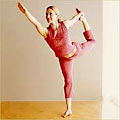
Regarding balance training, the type, duration and intensity of balance exercises is based on what a person is most comfortable starting with and will continue performing on a regular basis. When studied, no specific routine or approach appears to be superior. Unlike resistance training, you can and should do balance exercises daily.
A simple balance exercise:
See how long you can stand on one leg. You will need a stable structure (a doorway is a good choice) to hold on to before you even try to lift the leg. Practice a few times while holding on. Once you are comfortable, lift one leg slowly. Then slowly release your hands while keeping the leg lifted off the ground. Repeat with the other leg.
Measure the number of seconds you are able to keep the leg lifted without needing to grab the doorway or put the leg down. Balancing on one foot is an excellent exercise, and by measuring how long you can hold each leg up, you can keep track of your progress.
Here is a variation of balancing on one leg:
Do the exercise with repetitions. Balance on one foot for 10 seconds, then put the foot down for 10 seconds, and then raise it again. Do four to eight repetitions on each foot. Do this in a doorway or next to something stable that you can grab quickly if needed. After you have mastered this, try it with your eyes closed.
Once you are very comfortable with balancing on one foot, you can advance to the next stage. Balance on one foot, and hold the lifted foot in front of you before lowering it to the ground. You can then practice moving it backward and then sideways. Always stay in control by holding on with your hands as you need to.
Tai Chi, a series of slow, purposeful body movements coordinated with mindful breathing and mental focus, has gained popularity in Western countries as a way to improve balance and also increase muscle tone and strength.
Copyright © 2008 by the Presidents and Fellows of Harvard College. Used with permission of StayWell. All rights reserved. Harvard Medical School does not approve or endorse any products on the page. Harvard is the sole creator of its editorial content, and advertisers are not allowed to influence the language or images Harvard uses.
 Online Music Store